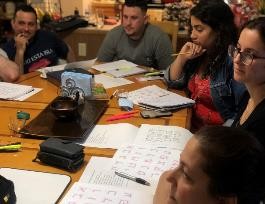
 Someone once said, “Education is about making life more pleasant for others.” In reality, adult classes often become tedious because, even in the attempt to make lessons more enjoyable, the content has been sacrificed. We have failed to understand that the issue lies in the form or method, not the content itself. A class using the Portions for Life at Way Up must be characterized by achieving deep, defining content for the believer, delivered in a form and methodology that the disciple (regardless of age, gender, or group affinity) can enjoy.
It is certainly true that the majority of people are frustrated as a result of the secular education system that has marked our modern history, but the kehilah or the church can make a difference. Therefore, the teaching of the portions must focus on two directions to achieve a comprehensive result:
1- Breaking the frustration and poor formation that people bring with them to the faith community.
2- Ensuring they enjoy what they are learning so that the assimilation and application of the content are better.
Something very important is that the learning process must be characterized by a dialogue between teachers and students, where everyone is learning and teaching at the same time. The teacher must not only deliver content that students do not know or master, but must also be a catalyst that enhances everyone’s comprehension. The good teacher, in this sense, is not the one who knows everything, but the one who is conscious of what they know and what they do not know. And even though their students do not have to know what the teacher does not know (although sometimes it may happen), the good teacher must be willing to say, “I don’t know, and I am willing to look it up!” It is true that some people have good knowledge, even through our Specialization Courses, but that doesn’t mean they are good teachers. Teaching is also an art for which God equips, and it begins by learning what to do and what not to do in a classroom so that disciples become better “disciples.”
The classroom, from the perspective of Way Up Foundation, is considered an adaptive space, as it is composed of multiple elements: complex beings with different backgrounds and interests, topics that are far more complex than the individuals because they come from the eternal mind of God, and the situational complexity inherent in each class session. Therefore, the teacher must be open to creativity and innovation in collaboration with other teachers and their students. They must be willing to eliminate everything that is counterproductive to the benefit of discipleship and incorporate everything that can develop it.
The challenge is to imagine and project how they could make their classroom better for their disciples and for themselves as teachers, where the appetite for learning can be cultivated and adequately satisfied.
Some advice for Adult Tutors and Supervisors:
- Verify that your disciples have access to the Portion of the Week.
- Create an important space for the Berakah (Blessing) or Benediction for the class. And allow freedom for anyone who feels the need to pray individually during the class to do so.
- Do not try to delve into every important point found in each portion, but rather those you consider most relevant to the present need of your pupils. Remember that when you return to this topic in three years, you can expand on what could not be explored in depth now.
- Be flexible with your class schedule, whether it means making it longer or shorter than the traditional 45 minutes often customary.
- Create Chavrutot (small study groups) so they can debate and share how their week went with the topic at hand.
- Use the questions that appear in each portion to facilitate study outside of class and debate.