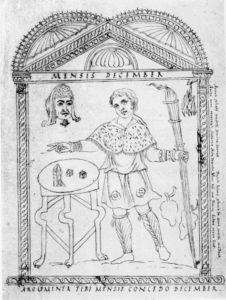
 Traditional history often presents the origin of Christmas as the result of a natural evolution of Christian devotion. However, a rigorous analysis of the Chronograph of 354 (which contains the record of festivities from the year 336 AD) reveals a far more pragmatic and political reality. The establishment of December 25th was not merely a liturgical act; it was, above all, a maneuver of public law designed to transform a once-persecuted faith into the backbone of the Roman Empire.
1. Roman Law and the Need for a “State Calendar”
In the Roman world, whatever was not recorded in the calendar did not legally exist. The Roman legal system was extremely meticulous regarding the fasti (the days permitted for business and religious observance). For the Church to cease being a marginal “superstition” and become a religio licita (a permitted religion), it needed to speak the language of the State: the language of temporal unification.
The Chronograph of 354 is, in essence, a response to the demands of Roman Law. By systematizing the feasts of the martyrs and fixing the birth of Christ, the Church was fulfilling the requirements of an official institution. The document allowed citizens like Valentinian—the aristocrat for whom the manuscript was created—to navigate their civil duties and their new religious obligations under a single, coherent administrative order.
2. The Legacy of Nicaea: Uniformity as a Power Strategy
The definitive institutionalization of Christianity required an end to the chaos of regional traditions. While the East favored Epiphany (January 6th), Rome understood that an institution divided in its dates was an institution weak in the face of imperial bureaucracy.
Following the Council of Nicaea (325 AD), which had already unified the date of Easter, the calendar of 336 functioned as the “architectural blueprint” for this new era. The fixing of Christmas was the logical step toward establishing a centralized authority. It was not just about remembering a birth, but about demonstrating that the Church possessed the capacity to dictate a universal time for the entire Empire, from Britannia to Syria.
3. The Substitution of Imperial Cult: From the Sun to Christ
The deepest political cause behind the date of December 25th was the supplantation of the Unconquered Sun (Sol Invictus). This was the tutelary deity of the emperors since Aurelian. By claiming the winter solstice, the Church was not only performing a task of “symbolic evangelization,” but was executing a deliberate act of power appropriation.
If the emperor was the source of light and order in paganism, State Christianity proposed Christ as the “Sun of Righteousness.” By placing Christmas at the heart of the Roman solar calendar, the Church positioned itself as the true manager of the Empire’s peace and order, symbolically displacing the emperor as the center of public worship to place itself in that position of privilege.
4. Conclusion: An Institution to Govern Time
Ultimately, the Chronograph of 354 was not a product of mystical theology, but of political realism. It was the tool that allowed Christianity to comply with the norms of Roman institutionality, unifying the faith under the standards of an imperial organization.
Through this calendar, Christianity ceased to be a movement of “secret meetings” and became an institution capable of governing public time. Christmas, therefore, was the gateway for the Church to transition from being just another institution of the Empire to finally becoming its primary and definitive institution. The controversy over its origin is not merely about a date, but about the moment the Gospel donned the toga of Roman Law.
By: Dr. Liber Aguiar
0 Comments