Golden Text: Deuteronomy 33:5
Readings for the week:
Day 1: Joshua 18-19
Day 2: 1 Chronicle 9
Day 3: 1 Kings 12-13
Day 4: Ezekiel 38-39
Day 5: Revelation 6
Day 6: Revelation 14


I- A divinely organized camp.
Israel, like a camp, in its passage through the wilderness was to be organized into four battalions of three tribes each and distributed around the tabernacle. This camp and its form of meeting would be a prophetic symbol of what it is like for God’s children to live together and worship Him[1].
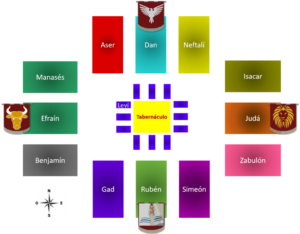
Recall that when Moses taught about this, he said that it was a model of what was in heaven[2]. Therefore, to look at this as an organization from which one would never leave would be a mistake. When he arrived in the promised land everything would change, but in theological memory he would continue to announce what was in heaven.
II- A structure that speaks.
The word for ‘tribe’ shevet (שֵׁבֶט), like the vast majority of Hebrew words, also has another meaning which is ‘rod’. This double meaning exists because in ancient times the ruler possessed a rod or scepter as a symbol of power and authority. So, in the same way the tribes had a power structure subject to the supreme authority.
Each side of the tabernacle was covered by a battalion composed of three tribes, and one of them led it. This tribe had a banner that symbolized each battalion in terms of characteristics, mission, and function[3]. Each of the twelve tribes was represented by the color of the stone that had been placed on the breastplate of the high priest’s garment, indicating that their function should be focused on a tireless love for all the people of God, which is why he wore them on his breastplate.
III- The number 12.
Most assume the number 12 of the tribes of Israel as an exact number, but it must be understood that in Semitic culture mathematics does not have the same use as it does in the West, its accuracy is not limited to specific and invariable values. In this case of the tribes, we know that Joseph’s tribe was divided into two others (Ephraim and Manasseh),[4] so if we add up there would be 13. How does God solve this, then dividing Levi’s tribe among the others and so the camp continues to be made up of 12.
A thirteenth-century scholar, Jacob Ben Asher, of Jacob’s blessings on his sons discovered that whenever a tribe is mentioned, if we took the numerical value of the first letter of the word and added all the first letters of those words that follow the name, the total sum would be 365 (that is, the days of the solar year). If parallel to this we do the same with the last letter of the last word of each blessing and add them together, the result is 354 (the days of the lunar year).[5] That inclusive detail of both calendars speaks of a total confirmation as to the full fulfillment of each of those blessings for all humanity, there is no way to avoid it.
Questions:
1.- What relationship do you see between the 12 tribes and the 12 apostles?
2.- According to one of the texts for the week, how do you think God prepared Israel to assimilate the Gentiles into the camp?
3.- In what sense do you interpret this camp as a model of what God wants for His people?
4.- Point out what you learn from the division of all the Levites into the 12 tribes of Israel.
5.- What relationship do you find between the organization of the camp and the four living beings of Rev 4?
[1] Rev 4.
[2] Ex 25:40; Acts 7:44.
[3] Num 2:2 tells us about the different flags because of the symbol of each tribe. In the following portions it will be detailed in the figure of the standard, as well as in the meanings of the names.
[4] On the other hand, it should be borne in mind when studying the biblical text in its entirety that in several places the tribe of Ephraim will be named after that of Joseph (2 Chronicles 2).
[5] Jr 31:35.
Under Construction..
Deuteronomy 33:5.
5 Thus the LORD became king in Jeshurun, when the heads of the people were gathered, all the tribes of Israel together.
Joshua 18.
1 Then the whole congregation of the people of Israel assembled at Shiloh and set up the tent of meeting there. The land lay subdued before them.
2 There remained among the people of Israel seven tribes whose inheritance had not yet been apportioned. 3 So Joshua said to the people of Israel, “How long will you put off going in to take possession of the land, which the LORD, the God of your fathers, has given you? 4 Provide three men from each tribe, and I will send them out that they may set out and go up and down the land. They shall write a description of it with a view to their inheritances, and then come to me. 5 They shall divide it into seven portions. Judah shall continue in his territory on the south, and the house of Joseph shall continue in their territory on the north. 6 And you shall describe the land in seven divisions and bring the description here to me. And I will cast lots for you here before the LORD our God. 7 The Levites have no portion among you, for the priesthood of the LORD is their heritage. And Gad and Reuben and half the tribe of Manasseh have received their inheritance beyond the Jordan eastward, which Moses the servant of the LORD gave them.”
8 So the men arose and went, and Joshua charged those who went to write the description of the land, saying, “Go up and down in the land and write a description and return to me. And I will cast lots for you here before the LORD in Shiloh.” 9 So the men went and passed up and down in the land and wrote in a book a description of it by towns in seven divisions. Then they came to Joshua to the camp at Shiloh, 10 and Joshua cast lots for them in Shiloh before the LORD. And there Joshua apportioned the land to the people of Israel, to each his portion.
11 The lot of the tribe of the people of Benjamin according to its clans came up, and the territory allotted to it fell between the people of Judah and the people of Joseph. 12 On the north side their boundary began at the Jordan. Then the boundary goes up to the shoulder north of Jericho, then up through the hill country westward, and it ends at the wilderness of Beth-aven. 13 From there the boundary passes along southward in the direction of Luz, to the shoulder of Luz (that is, Bethel), then the boundary goes down to Ataroth-addar, on the mountain that lies south of Lower Beth-horon. 14 Then the boundary goes in another direction, turning on the western side southward from the mountain that lies to the south, opposite Beth-horon, and it ends at Kiriath-baal (that is, Kiriath-jearim), a city belonging to the people of Judah. This forms the western side. 15 And the southern side begins at the outskirts of Kiriath-jearim. And the boundary goes from there to Ephron, to the spring of the waters of Nephtoah. 16 Then the boundary goes down to the border of the mountain that overlooks the Valley of the Son of Hinnom, which is at the north end of the Valley of Rephaim. And it then goes down the Valley of Hinnom, south of the shoulder of the Jebusites, and downward to En-rogel. 17 Then it bends in a northerly direction going on to En-shemesh, and from there goes to Geliloth, which is opposite the ascent of Adummim. Then it goes down to the stone of Bohan the son of Reuben, 18 and passing on to the north of the shoulder of Beth-arabah it goes down to the Arabah. 19 Then the boundary passes on to the north of the shoulder of Beth-hoglah. And the boundary ends at the northern bay of the Salt Sea, at the south end of the Jordan: this is the southern border. 20 The Jordan forms its boundary on the eastern side. This is the inheritance of the people of Benjamin, according to their clans, boundary by boundary all around.
21 Now the cities of the tribe of the people of Benjamin according to their clans were Jericho, Beth-hoglah, Emek-keziz, 22 Beth-arabah, Zemaraim, Bethel, 23 Avvim, Parah, Ophrah, 24 Chephar-ammoni, Ophni, Geba—twelve cities with their villages: 25 Gibeon, Ramah, Beeroth, 26 Mizpeh, Chephirah, Mozah, 27 Rekem, Irpeel, Taralah, 28 Zela, Haeleph, Jebus (that is, Jerusalem), Gibeah and Kiriath-jearim—fourteen cities with their villages. This is the inheritance of the people of Benjamin according to its clans.
Joshua 19.
1 The second lot came out for Simeon, for the tribe of the people of Simeon, according to their clans, and their inheritance was in the midst of the inheritance of the people of Judah. 2 And they had for their inheritance Beersheba, Sheba, Moladah, 3 Hazar-shual, Balah, Ezem, 4 Eltolad, Bethul, Hormah, 5 Ziklag, Beth-marcaboth, Hazar-susah, 6 Beth-lebaoth, and Sharuhen—thirteen cities with their villages; 7 Ain, Rimmon, Ether, and Ashan—four cities with their villages, 8 together with all the villages around these cities as far as Baalath-beer, Ramah of the Negeb. This was the inheritance of the tribe of the people of Simeon according to their clans. 9 The inheritance of the people of Simeon formed part of the territory of the people of Judah. Because the portion of the people of Judah was too large for them, the people of Simeon obtained an inheritance in the midst of their inheritance.
10 The third lot came up for the people of Zebulun, according to their clans. And the territory of their inheritance reached as far as Sarid. 11 Then their boundary goes up westward and on to Mareal and touches Dabbesheth, then the brook that is east of Jokneam. 12 From Sarid it goes in the other direction eastward toward the sunrise to the boundary of Chisloth-tabor. From there it goes to Daberath, then up to Japhia. 13 From there it passes along on the east toward the sunrise to Gath-hepher, to Eth-kazin, and going on to Rimmon it bends toward Neah, 14 then on the north the boundary turns about to Hannathon, and it ends at the Valley of Iphtahel; 15 and Kattath, Nahalal, Shimron, Idalah, and Bethlehem—twelve cities with their villages. 16 This is the inheritance of the people of Zebulun, according to their clans—these cities with their villages.
17 The fourth lot came out for Issachar, for the people of Issachar, according to their clans. 18 Their territory included Jezreel, Chesulloth, Shunem, 19 Hapharaim, Shion, Anaharath, 20 Rabbith, Kishion, Ebez, 21 Remeth, En-gannim, En-haddah, Beth-pazzez. 22 The boundary also touches Tabor, Shahazumah, and Beth-shemesh, and its boundary ends at the Jordan—sixteen cities with their villages. 23 This is the inheritance of the tribe of the people of Issachar, according to their clans—the cities with their villages.
24 The fifth lot came out for the tribe of the people of Asher according to their clans. 25 Their territory included Helkath, Hali, Beten, Achshaph, 26 Allammelech, Amad, and Mishal. On the west it touches Carmel and Shihor-libnath, 27 then it turns eastward, it goes to Beth-dagon, and touches Zebulun and the Valley of Iphtahel northward to Beth-emek and Neiel. Then it continues in the north to Cabul, 28 Ebron, Rehob, Hammon, Kanah, as far as Sidon the Great. 29 Then the boundary turns to Ramah, reaching to the fortified city of Tyre. Then the boundary turns to Hosah, and it ends at the sea; Mahalab, Achzib, 30 Ummah, Aphek and Rehob—twenty-two cities with their villages. 31 This is the inheritance of the tribe of the people of Asher according to their clans—these cities with their villages.
32 The sixth lot came out for the people of Naphtali, for the people of Naphtali, according to their clans. 33 And their boundary ran from Heleph, from the oak in Zaanannim, and Adami-nekeb, and Jabneel, as far as Lakkum, and it ended at the Jordan. 34 Then the boundary turns westward to Aznoth-tabor and goes from there to Hukkok, touching Zebulun at the south and Asher on the west and Judah on the east at the Jordan. 35 The fortified cities are Ziddim, Zer, Hammath, Rakkath, Chinnereth, 36 Adamah, Ramah, Hazor, 37 Kedesh, Edrei, En-hazor, 38 Yiron, Migdal-el, Horem, Beth-anath, and Beth-shemesh—nineteen cities with their villages. 39 This is the inheritance of the tribe of the people of Naphtali according to their clans—the cities with their villages.
40 The seventh lot came out for the tribe of the people of Dan, according to their clans. 41 And the territory of its inheritance included Zorah, Eshtaol, Ir-shemesh, 42 Shaalabbin, Aijalon, Ithlah, 43 Elon, Timnah, Ekron, 44 Eltekeh, Gibbethon, Baalath, 45 Jehud, Bene-berak, Gath-rimmon, 46 and Me-jarkon and Rakkon with the territory over against Joppa. 47 When the territory of the people of Dan was lost to them, the people of Dan went up and fought against Leshem, and after capturing it and striking it with the sword they took possession of it and settled in it, calling Leshem, Dan, after the name of Dan their ancestor. 48 This is the inheritance of the tribe of the people of Dan, according to their clans—these cities with their villages.
49 When they had finished distributing the several territories of the land as inheritances, the people of Israel gave an inheritance among them to Joshua the son of Nun. 50 By command of the LORD they gave him the city that he asked, Timnath-serah in the hill country of Ephraim. And he rebuilt the city and settled in it.
51 These are the inheritances that Eleazar the priest and Joshua the son of Nun and the heads of the fathers’ houses of the tribes of the people of Israel distributed by lot at Shiloh before the LORD, at the entrance of the tent of meeting. So they finished dividing the land.
1 Chronicle 9.
1 So all Israel was recorded in genealogies, and these are written in the Book of the Kings of Israel. And Judah was taken into exile in Babylon because of their breach of faith. 2 Now the first to dwell again in their possessions in their cities were Israel, the priests, the Levites, and the temple servants. 3 And some of the people of Judah, Benjamin, Ephraim, and Manasseh lived in Jerusalem: 4 Uthai the son of Ammihud, son of Omri, son of Imri, son of Bani, from the sons of Perez the son of Judah. 5 And of the Shilonites: Asaiah the firstborn, and his sons. 6 Of the sons of Zerah: Jeuel and their kinsmen, 690. 7 Of the Benjaminites: Sallu the son of Meshullam, son of Hodaviah, son of Hassenuah, 8 Ibneiah the son of Jeroham, Elah the son of Uzzi, son of Michri, and Meshullam the son of Shephatiah, son of Reuel, son of Ibnijah; 9 and their kinsmen according to their generations, 956. All these were heads of fathers’ houses according to their fathers’ houses.
10 Of the priests: Jedaiah, Jehoiarib, Jachin, 11 and Azariah the son of Hilkiah, son of Meshullam, son of Zadok, son of Meraioth, son of Ahitub, the chief officer of the house of God; 12 and Adaiah the son of Jeroham, son of Pashhur, son of Malchijah, and Maasai the son of Adiel, son of Jahzerah, son of Meshullam, son of Meshillemith, son of Immer; 13 besides their kinsmen, heads of their fathers’ houses, 1,760, mighty men for the work of the service of the house of God.
14 Of the Levites: Shemaiah the son of Hasshub, son of Azrikam, son of Hashabiah, of the sons of Merari; 15 and Bakbakkar, Heresh, Galal and Mattaniah the son of Mica, son of Zichri, son of Asaph; 16 and Obadiah the son of Shemaiah, son of Galal, son of Jeduthun, and Berechiah the son of Asa, son of Elkanah, who lived in the villages of the Netophathites.
17 The gatekeepers were Shallum, Akkub, Talmon, Ahiman, and their kinsmen (Shallum was the chief); 18 until then they were in the king’s gate on the east side as the gatekeepers of the camps of the Levites. 19 Shallum the son of Kore, son of Ebiasaph, son of Korah, and his kinsmen of his fathers’ house, the Korahites, were in charge of the work of the service, keepers of the thresholds of the tent, as their fathers had been in charge of the camp of the LORD, keepers of the entrance. 20 And Phinehas the son of Eleazar was the chief officer over them in time past; the LORD was with him. 21 Zechariah the son of Meshelemiah was gatekeeper at the entrance of the tent of meeting. 22 All these, who were chosen as gatekeepers at the thresholds, were 212. They were enrolled by genealogies in their villages. David and Samuel the seer established them in their office of trust. 23 So they and their sons were in charge of the gates of the house of the LORD, that is, the house of the tent, as guards. 24 The gatekeepers were on the four sides, east, west, north, and south. 25 And their kinsmen who were in their villages were obligated to come in every seven days, in turn, to be with these, 26 for the four chief gatekeepers, who were Levites, were entrusted to be over the chambers and the treasures of the house of God. 27 And they lodged around the house of God, for on them lay the duty of watching, and they had charge of opening it every morning.
28 Some of them had charge of the utensils of service, for they were required to count them when they were brought in and taken out. 29 Others of them were appointed over the furniture and over all the holy utensils, also over the fine flour, the wine, the oil, the incense, and the spices. 30 Others, of the sons of the priests, prepared the mixing of the spices, 31 and Mattithiah, one of the Levites, the firstborn of Shallum the Korahite, was entrusted with making the flat cakes. 32 Also some of their kinsmen of the Kohathites had charge of the showbread, to prepare it every Sabbath.
33 Now these, the singers, the heads of fathers’ houses of the Levites, were in the chambers of the temple free from other service, for they were on duty day and night. 34 These were heads of fathers’ houses of the Levites, according to their generations, leaders. These lived in Jerusalem.
35 In Gibeon lived the father of Gibeon, Jeiel, and the name of his wife was Maacah, 36 and his firstborn son Abdon, then Zur, Kish, Baal, Ner, Nadab, 37 Gedor, Ahio, Zechariah, and Mikloth; 38 and Mikloth was the father of Shimeam; and these also lived opposite their kinsmen in Jerusalem, with their kinsmen. 39 Ner fathered Kish, Kish fathered Saul, Saul fathered Jonathan, Malchi-shua, Abinadab, and Eshbaal. 40 And the son of Jonathan was Merib-baal, and Merib-baal fathered Micah. 41 The sons of Micah: Pithon, Melech, Tahrea, and Ahaz. 42 And Ahaz fathered Jarah, and Jarah fathered Alemeth, Azmaveth, and Zimri. And Zimri fathered Moza. 43 Moza fathered Binea, and Rephaiah was his son, Eleasah his son, Azel his son. 44 Azel had six sons and these are their names: Azrikam, Bocheru, Ishmael, Sheariah, Obadiah, and Hanan; these were the sons of Azel.
1 Kings 12.
1 Rehoboam went to Shechem, for all Israel had come to Shechem to make him king. 2 And as soon as Jeroboam the son of Nebat heard of it (for he was still in Egypt, where he had fled from King Solomon), then Jeroboam returned from Egypt. 3 And they sent and called him, and Jeroboam and all the assembly of Israel came and said to Rehoboam, 4 “Your father made our yoke heavy. Now therefore lighten the hard service of your father and his heavy yoke on us, and we will serve you.” 5 He said to them, “Go away for three days, then come again to me.” So the people went away.
6 Then King Rehoboam took counsel with the old men, who had stood before Solomon his father while he was yet alive, saying, “How do you advise me to answer this people?” 7 And they said to him, “If you will be a servant to this people today and serve them, and speak good words to them when you answer them, then they will be your servants forever.” 8 But he abandoned the counsel that the old men gave him and took counsel with the young men who had grown up with him and stood before him. 9 And he said to them, “What do you advise that we answer this people who have said to me, ‘Lighten the yoke that your father put on us’?” 10 And the young men who had grown up with him said to him, “Thus shall you speak to this people who said to you, ‘Your father made our yoke heavy, but you lighten it for us,’ thus shall you say to them, ‘My little finger is thicker than my father’s thighs. 11 And now, whereas my father laid on you a heavy yoke, I will add to your yoke. My father disciplined you with whips, but I will discipline you with scorpions.’ ”
12 So Jeroboam and all the people came to Rehoboam the third day, as the king said, “Come to me again the third day.” 13 And the king answered the people harshly, and forsaking the counsel that the old men had given him, 14 he spoke to them according to the counsel of the young men, saying, “My father made your yoke heavy, but I will add to your yoke. My father disciplined you with whips, but I will discipline you with scorpions.” 15 So the king did not listen to the people, for it was a turn of affairs brought about by the LORD that he might fulfill his word, which the LORD spoke by Ahijah the Shilonite to Jeroboam the son of Nebat.
16 And when all Israel saw that the king did not listen to them, the people answered the king, “What portion do we have in David? We have no inheritance in the son of Jesse. To your tents, O Israel! Look now to your own house, David.” So Israel went to their tents. 17 But Rehoboam reigned over the people of Israel who lived in the cities of Judah. 18 Then King Rehoboam sent Adoram, who was taskmaster over the forced labor, and all Israel stoned him to death with stones. And King Rehoboam hurried to mount his chariot to flee to Jerusalem. 19 So Israel has been in rebellion against the house of David to this day. 20 And when all Israel heard that Jeroboam had returned, they sent and called him to the assembly and made him king over all Israel. There was none that followed the house of David but the tribe of Judah only.
21 When Rehoboam came to Jerusalem, he assembled all the house of Judah and the tribe of Benjamin, 180,000 chosen warriors, to fight against the house of Israel, to restore the kingdom to Rehoboam the son of Solomon. 22 But the word of God came to Shemaiah the man of God: 23 “Say to Rehoboam the son of Solomon, king of Judah, and to all the house of Judah and Benjamin, and to the rest of the people, 24 ‘Thus says the LORD, You shall not go up or fight against your relatives the people of Israel. Every man return to his home, for this thing is from me.’ ” So they listened to the word of the LORD and went home again, according to the word of the LORD.
25 Then Jeroboam built Shechem in the hill country of Ephraim and lived there. And he went out from there and built Penuel. 26 And Jeroboam said in his heart, “Now the kingdom will turn back to the house of David. 27 If this people go up to offer sacrifices in the temple of the LORD at Jerusalem, then the heart of this people will turn again to their lord, to Rehoboam king of Judah, and they will kill me and return to Rehoboam king of Judah.” 28 So the king took counsel and made two calves of gold. And he said to the people, “You have gone up to Jerusalem long enough. Behold your gods, O Israel, who brought you up out of the land of Egypt.” 29 And he set one in Bethel, and the other he put in Dan. 30 Then this thing became a sin, for the people went as far as Dan to be before one. 31 He also made temples on high places and appointed priests from among all the people, who were not of the Levites. 32 And Jeroboam appointed a feast on the fifteenth day of the eighth month like the feast that was in Judah, and he offered sacrifices on the altar. So he did in Bethel, sacrificing to the calves that he made. And he placed in Bethel the priests of the high places that he had made. 33 He went up to the altar that he had made in Bethel on the fifteenth day in the eighth month, in the month that he had devised from his own heart. And he instituted a feast for the people of Israel and went up to the altar to make offerings.
1 Kings 13.
1 And behold, a man of God came out of Judah by the word of the LORD to Bethel. Jeroboam was standing by the altar to make offerings. 2 And the man cried against the altar by the word of the LORD and said, “O altar, altar, thus says the LORD: ‘Behold, a son shall be born to the house of David, Josiah by name, and he shall sacrifice on you the priests of the high places who make offerings on you, and human bones shall be burned on you.’ ” 3 And he gave a sign the same day, saying, “This is the sign that the LORD has spoken: ‘Behold, the altar shall be torn down, and the ashes that are on it shall be poured out.’ ” 4 And when the king heard the saying of the man of God, which he cried against the altar at Bethel, Jeroboam stretched out his hand from the altar, saying, “Seize him.” And his hand, which he stretched out against him, dried up, so that he could not draw it back to himself. 5 The altar also was torn down, and the ashes poured out from the altar, according to the sign that the man of God had given by the word of the LORD. 6 And the king said to the man of God, “Entreat now the favor of the LORD your God, and pray for me, that my hand may be restored to me.” And the man of God entreated the LORD, and the king’s hand was restored to him and became as it was before. 7 And the king said to the man of God, “Come home with me, and refresh yourself, and I will give you a reward.” 8 And the man of God said to the king, “If you give me half your house, I will not go in with you. And I will not eat bread or drink water in this place, 9 for so was it commanded me by the word of the LORD, saying, ‘You shall neither eat bread nor drink water nor return by the way that you came.’ ” 10 So he went another way and did not return by the way that he came to Bethel.
11 Now an old prophet lived in Bethel. And his sons came and told him all that the man of God had done that day in Bethel. They also told to their father the words that he had spoken to the king. 12 And their father said to them, “Which way did he go?” And his sons showed him the way that the man of God who came from Judah had gone. 13 And he said to his sons, “Saddle the donkey for me.” So they saddled the donkey for him and he mounted it. 14 And he went after the man of God and found him sitting under an oak. And he said to him, “Are you the man of God who came from Judah?” And he said, “I am.” 15 Then he said to him, “Come home with me and eat bread.” 16 And he said, “I may not return with you, or go in with you, neither will I eat bread nor drink water with you in this place, 17 for it was said to me by the word of the LORD, ‘You shall neither eat bread nor drink water there, nor return by the way that you came.’ ” 18 And he said to him, “I also am a prophet as you are, and an angel spoke to me by the word of the LORD, saying, ‘Bring him back with you into your house that he may eat bread and drink water.’ ” But he lied to him. 19 So he went back with him and ate bread in his house and drank water.
20 And as they sat at the table, the word of the LORD came to the prophet who had brought him back. 21 And he cried to the man of God who came from Judah, “Thus says the LORD, ‘Because you have disobeyed the word of the LORD and have not kept the command that the LORD your God commanded you, 22 but have come back and have eaten bread and drunk water in the place of which he said to you, “Eat no bread and drink no water,” your body shall not come to the tomb of your fathers.’ ” 23 And after he had eaten bread and drunk, he saddled the donkey for the prophet whom he had brought back. 24 And as he went away a lion met him on the road and killed him. And his body was thrown in the road, and the donkey stood beside it; the lion also stood beside the body. 25 And behold, men passed by and saw the body thrown in the road and the lion standing by the body. And they came and told it in the city where the old prophet lived.
26 And when the prophet who had brought him back from the way heard of it, he said, “It is the man of God who disobeyed the word of the LORD; therefore the LORD has given him to the lion, which has torn him and killed him, according to the word that the LORD spoke to him.” 27 And he said to his sons, “Saddle the donkey for me.” And they saddled it. 28 And he went and found his body thrown in the road, and the donkey and the lion standing beside the body. The lion had not eaten the body or torn the donkey. 29 And the prophet took up the body of the man of God and laid it on the donkey and brought it back to the city to mourn and to bury him. 30 And he laid the body in his own grave. And they mourned over him, saying, “Alas, my brother!” 31 And after he had buried him, he said to his sons, “When I die, bury me in the grave in which the man of God is buried; lay my bones beside his bones. 32 For the saying that he called out by the word of the LORD against the altar in Bethel and against all the houses of the high places that are in the cities of Samaria shall surely come to pass.”
33 After this thing Jeroboam did not turn from his evil way, but made priests for the high places again from among all the people. Any who would, he ordained to be priests of the high places. 34 And this thing became sin to the house of Jeroboam, so as to cut it off and to destroy it from the face of the earth.
Ezekiel 38.
1 The word of the LORD came to me: 2 “Son of man, set your face toward Gog, of the land of Magog, the chief prince of Meshech and Tubal, and prophesy against him 3 and say, Thus says the Lord GOD: Behold, I am against you, O Gog, chief prince of Meshech and Tubal. 4 And I will turn you about and put hooks into your jaws, and I will bring you out, and all your army, horses and horsemen, all of them clothed in full armor, a great host, all of them with buckler and shield, wielding swords. 5 Persia, Cush, and Put are with them, all of them with shield and helmet; 6 Gomer and all his hordes; Beth-togarmah from the uttermost parts of the north with all his hordes—many peoples are with you.
7 “Be ready and keep ready, you and all your hosts that are assembled about you, and be a guard for them. 8 After many days you will be mustered. In the latter years you will go against the land that is restored from war, the land whose people were gathered from many peoples upon the mountains of Israel, which had been a continual waste. Its people were brought out from the peoples and now dwell securely, all of them. 9 You will advance, coming on like a storm. You will be like a cloud covering the land, you and all your hordes, and many peoples with you.
10 “Thus says the Lord GOD: On that day, thoughts will come into your mind, and you will devise an evil scheme 11 and say, ‘I will go up against the land of unwalled villages. I will fall upon the quiet people who dwell securely, all of them dwelling without walls, and having no bars or gates,’ 12 to seize spoil and carry off plunder, to turn your hand against the waste places that are now inhabited, and the people who were gathered from the nations, who have acquired livestock and goods, who dwell at the center of the earth. 13 Sheba and Dedan and the merchants of Tarshish and all its leaders will say to you, ‘Have you come to seize spoil? Have you assembled your hosts to carry off plunder, to carry away silver and gold, to take away livestock and goods, to seize great spoil?’
14 “Therefore, son of man, prophesy, and say to Gog, Thus says the Lord GOD: On that day when my people Israel are dwelling securely, will you not know it? 15 You will come from your place out of the uttermost parts of the north, you and many peoples with you, all of them riding on horses, a great host, a mighty army. 16 You will come up against my people Israel, like a cloud covering the land. In the latter days I will bring you against my land, that the nations may know me, when through you, O Gog, I vindicate my holiness before their eyes.
17 “Thus says the Lord GOD: Are you he of whom I spoke in former days by my servants the prophets of Israel, who in those days prophesied for years that I would bring you against them? 18 But on that day, the day that Gog shall come against the land of Israel, declares the Lord GOD, my wrath will be roused in my anger. 19 For in my jealousy and in my blazing wrath I declare, On that day there shall be a great earthquake in the land of Israel. 20 The fish of the sea and the birds of the heavens and the beasts of the field and all creeping things that creep on the ground, and all the people who are on the face of the earth, shall quake at my presence. And the mountains shall be thrown down, and the cliffs shall fall, and every wall shall tumble to the ground. 21 I will summon a sword against Gog on all my mountains, declares the Lord GOD. Every man’s sword will be against his brother. 22 With pestilence and bloodshed I will enter into judgment with him, and I will rain upon him and his hordes and the many peoples who are with him torrential rains and hailstones, fire and sulfur. 23 So I will show my greatness and my holiness and make myself known in the eyes of many nations. Then they will know that I am the LORD.
Ezekiel 39.
1 “And you, son of man, prophesy against Gog and say, Thus says the Lord GOD: Behold, I am against you, O Gog, chief prince of Meshech and Tubal. 2 And I will turn you about and drive you forward, and bring you up from the uttermost parts of the north, and lead you against the mountains of Israel. 3 Then I will strike your bow from your left hand, and will make your arrows drop out of your right hand. 4 You shall fall on the mountains of Israel, you and all your hordes and the peoples who are with you. I will give you to birds of prey of every sort and to the beasts of the field to be devoured. 5 You shall fall in the open field, for I have spoken, declares the Lord GOD. 6 I will send fire on Magog and on those who dwell securely in the coastlands, and they shall know that I am the LORD.
7 “And my holy name I will make known in the midst of my people Israel, and I will not let my holy name be profaned anymore. And the nations shall know that I am the LORD, the Holy One in Israel. 8 Behold, it is coming and it will be brought about, declares the Lord GOD. That is the day of which I have spoken.
9 “Then those who dwell in the cities of Israel will go out and make fires of the weapons and burn them, shields and bucklers, bow and arrows, clubs and spears; and they will make fires of them for seven years, 10 so that they will not need to take wood out of the field or cut down any out of the forests, for they will make their fires of the weapons. They will seize the spoil of those who despoiled them, and plunder those who plundered them, declares the Lord GOD.
11 “On that day I will give to Gog a place for burial in Israel, the Valley of the Travelers, east of the sea. It will block the travelers, for there Gog and all his multitude will be buried. It will be called the Valley of Hamon-gog. 12 For seven months the house of Israel will be burying them, in order to cleanse the land. 13 All the people of the land will bury them, and it will bring them renown on the day that I show my glory, declares the Lord GOD. 14 They will set apart men to travel through the land regularly and bury those travelers remaining on the face of the land, so as to cleanse it. At the end of seven months they will make their search. 15 And when these travel through the land and anyone sees a human bone, then he shall set up a sign by it, till the buriers have buried it in the Valley of Hamon-gog. 16 (Hamonah is also the name of the city.) Thus shall they cleanse the land.
17 “As for you, son of man, thus says the Lord GOD: Speak to the birds of every sort and to all beasts of the field: ‘Assemble and come, gather from all around to the sacrificial feast that I am preparing for you, a great sacrificial feast on the mountains of Israel, and you shall eat flesh and drink blood. 18 You shall eat the flesh of the mighty, and drink the blood of the princes of the earth—of rams, of lambs, and of he-goats, of bulls, all of them fat beasts of Bashan. 19 And you shall eat fat till you are filled, and drink blood till you are drunk, at the sacrificial feast that I am preparing for you. 20 And you shall be filled at my table with horses and charioteers, with mighty men and all kinds of warriors,’ declares the Lord GOD.
21 “And I will set my glory among the nations, and all the nations shall see my judgment that I have executed, and my hand that I have laid on them. 22 The house of Israel shall know that I am the LORD their God, from that day forward. 23 And the nations shall know that the house of Israel went into captivity for their iniquity, because they dealt so treacherously with me that I hid my face from them and gave them into the hand of their adversaries, and they all fell by the sword. 24 I dealt with them according to their uncleanness and their transgressions, and hid my face from them.
25 “Therefore thus says the Lord GOD: Now I will restore the fortunes of Jacob and have mercy on the whole house of Israel, and I will be jealous for my holy name. 26 They shall forget their shame and all the treachery they have practiced against me, when they dwell securely in their land with none to make them afraid, 27 when I have brought them back from the peoples and gathered them from their enemies’ lands, and through them have vindicated my holiness in the sight of many nations. 28 Then they shall know that I am the LORD their God, because I sent them into exile among the nations and then assembled them into their own land. I will leave none of them remaining among the nations anymore. 29 And I will not hide my face anymore from them, when I pour out my Spirit upon the house of Israel, declares the Lord GOD.”
Revelation 6.
1 Now I watched when the Lamb opened one of the seven seals, and I heard one of the four living creatures say with a voice like thunder, “Come!” 2 And I looked, and behold, a white horse! And its rider had a bow, and a crown was given to him, and he came out conquering, and to conquer.
3 When he opened the second seal, I heard the second living creature say, “Come!” 4 And out came another horse, bright red. Its rider was permitted to take peace from the earth, so that people should slay one another, and he was given a great sword.
5 When he opened the third seal, I heard the third living creature say, “Come!” And I looked, and behold, a black horse! And its rider had a pair of scales in his hand. 6 And I heard what seemed to be a voice in the midst of the four living creatures, saying, “A quart of wheat for a denarius, and three quarts of barley for a denarius, and do not harm the oil and wine!”
7 When he opened the fourth seal, I heard the voice of the fourth living creature say, “Come!” 8 And I looked, and behold, a pale horse! And its rider’s name was Death, and Hades followed him. And they were given authority over a fourth of the earth, to kill with sword and with famine and with pestilence and by wild beasts of the earth.
9 When he opened the fifth seal, I saw under the altar the souls of those who had been slain for the word of God and for the witness they had borne. 10 They cried out with a loud voice, “O Sovereign Lord, holy and true, how long before you will judge and avenge our blood on those who dwell on the earth?” 11 Then they were each given a white robe and told to rest a little longer, until the number of their fellow servants and their brothers should be complete, who were to be killed as they themselves had been.
12 When he opened the sixth seal, I looked, and behold, there was a great earthquake, and the sun became black as sackcloth, the full moon became like blood, 13 and the stars of the sky fell to the earth as the fig tree sheds its winter fruit when shaken by a gale. 14 The sky vanished like a scroll that is being rolled up, and every mountain and island was removed from its place. 15 Then the kings of the earth and the great ones and the generals and the rich and the powerful, and everyone, slave and free, hid themselves in the caves and among the rocks of the mountains, 16 calling to the mountains and rocks, “Fall on us and hide us from the face of him who is seated on the throne, and from the wrath of the Lamb, 17 for the great day of their wrath has come, and who can stand?”
Revelation 14.
1 Then I looked, and behold, on Mount Zion stood the Lamb, and with him 144,000 who had his name and his Father’s name written on their foreheads. 2 And I heard a voice from heaven like the roar of many waters and like the sound of loud thunder. The voice I heard was like the sound of harpists playing on their harps, 3 and they were singing a new song before the throne and before the four living creatures and before the elders. No one could learn that song except the 144,000 who had been redeemed from the earth. 4 It is these who have not defiled themselves with women, for they are virgins. It is these who follow the Lamb wherever he goes. These have been redeemed from mankind as firstfruits for God and the Lamb, 5 and in their mouth no lie was found, for they are blameless.
6 Then I saw another angel flying directly overhead, with an eternal gospel to proclaim to those who dwell on earth, to every nation and tribe and language and people. 7 And he said with a loud voice, “Fear God and give him glory, because the hour of his judgment has come, and worship him who made heaven and earth, the sea and the springs of water.”
8 Another angel, a second, followed, saying, “Fallen, fallen is Babylon the great, she who made all nations drink the wine of the passion of her sexual immorality.”
9 And another angel, a third, followed them, saying with a loud voice, “If anyone worships the beast and its image and receives a mark on his forehead or on his hand, 10 he also will drink the wine of God’s wrath, poured full strength into the cup of his anger, and he will be tormented with fire and sulfur in the presence of the holy angels and in the presence of the Lamb. 11 And the smoke of their torment goes up forever and ever, and they have no rest, day or night, these worshipers of the beast and its image, and whoever receives the mark of its name.”
12 Here is a call for the endurance of the saints, those who keep the commandments of God and their faith in Jesus.
13 And I heard a voice from heaven saying, “Write this: Blessed are the dead who die in the Lord from now on.” “Blessed indeed,” says the Spirit, “that they may rest from their labors, for their deeds follow them!”
14 Then I looked, and behold, a white cloud, and seated on the cloud one like a son of man, with a golden crown on his head, and a sharp sickle in his hand. 15 And another angel came out of the temple, calling with a loud voice to him who sat on the cloud, “Put in your sickle, and reap, for the hour to reap has come, for the harvest of the earth is fully ripe.” 16 So he who sat on the cloud swung his sickle across the earth, and the earth was reaped.
17 Then another angel came out of the temple in heaven, and he too had a sharp sickle. 18 And another angel came out from the altar, the angel who has authority over the fire, and he called with a loud voice to the one who had the sharp sickle, “Put in your sickle and gather the clusters from the vine of the earth, for its grapes are ripe.” 19 So the angel swung his sickle across the earth and gathered the grape harvest of the earth and threw it into the great winepress of the wrath of God. 20 And the winepress was trodden outside the city, and blood flowed from the winepress, as high as a horse’s bridle, for 1,600 stadia.