 Within the vast tapestry of Judaism, there is a current that, although a minority today, once represented the greatest intellectual and theological challenge to oral tradition. This is Karaism (from the Hebrew Qara’im, “readers” or “followers of the Scripture”), a branch that proposes a radical return to the written text: the TaNaK.
1. The Origins: A Sadducean Renaissance?
To understand the emergence of Karaism in the 8th century CE, it is inevitable to look back at the turbulent period of the Second Temple. Many historians have labeled Karaism as a “neo-Sadduceeism,” but this relationship is more of a methodological heritage than an exact replica.
The DNA of “Sola Scriptura”:
The strongest connection lies in the absolute rejection of the Oral Torah. Much like the ancient Sadducees, the Karaites broke away from the authority of traditions added by the Sages (Pharisees in antiquity, Rabbis in the Middle Ages), maintaining that only what is written is binding.
However, a fundamental evolution exists between the two groups:
-
The Sadducees: Traditionally associated with an observance centered almost exclusively on the Torah of Moses (Pentateuco), granting the Prophets a secondary or purely historical value.
-
The Karaites: They took a step further by embracing the 24 books of the Tanakh as an organic body. For them, the rest of the Scriptures (Prophets and Writings) are not only inspired word but the essential philological tool for deciphering the Hebrew of the Torah.
From Politics to Textual Analysis:
While Sadduceeism was a priestly and political elite linked to the Temple, Karaism was born in the Diaspora as a movement of scholarship and grammar. No longer living in an era where Hebrew was the everyday language of the street, the Karaites used the entire Tanakh as a “divine dictionary.” If a law in Leviticus appeared ambiguous, they sought linguistic analogies in the Psalms or Isaiah to extract its technical meaning.
This transition allowed the spirit of resistance against the Rabbinic monopoly to survive. It was not simply a matter of “disbelieving” in the Talmud, but of proposing that truth resides in personal investigation (itju) and in the rigorous analysis of the syntax and morphology of every word revealed in the 24 sacred books.
A “Qumran-style” Missing Link:
It is fascinating to note that the Karaite “renaissance” may have been fueled by the discovery of ancient manuscripts. Authors like Al-Qirqisani suggest that dissident groups found scrolls in caves (possibly related to the Essenes or Sadducean sectors of Qumran) that reinforced their vision of a Judaism based strictly on the text, far from the interpretations accumulated over centuries of oral tradition.
2. An Orthodox Worldview.
It is a common mistake to think of Karaism as a “watered-down” version of Judaism. On the contrary, its rigor is often greater than that of Rabbinic Judaism. Despite their rejection of the Talmud, Karaites maintain a worldview very similar to the Rabbinic one in its fundamentals:
-
Absolute ethical monotheism.
-
The centrality of Shabbat and purity laws.
-
The Messianic hope.
The difference lies in the source of authority. While Rabbinic Judaism views the Talmud as the “instruction manual” necessary to understand the Torah, Karaism applies the principle of itju (investigation): every individual has the responsibility to study the original text. As Anan ben David himself said: “Search well in the Scripture and do not rely on my opinion.”
3. The Great Point of Friction.
The divergence between Karaism and Rabbinic Judaism is not merely theoretical; it manifests in a daily praxis that alters the rhythm of time, the posture of the body before the Divine, and the cycle of celebrations. By rejecting the “fence around the Torah” built by the Sages of the Talmud, the Karaites maintain customs that appear almost unrecognizable to the modern observer.
Calendar and Observation:
The most evident fracture occurs in the calendar. While Rabbinic Judaism is governed by a fixed mathematical calculation system (established by Hillel II in the 4th century), Karaites insist on physical evidence:
-
The New Moon (Rosh Chodesh): The month only begins when the first sliver of the moon is visible to the naked eye from the land of Israel. They do not accept prior astronomical calculations if there are no witnesses to the lunar appearance.
-
The Aviv (The Barley): The Torah commands the celebration of Passover in the month of “ripened barley.” Therefore, Karaites annually inspect the fields in Israel. If the barley has not reached the state of Aviv, a leap month is added to the calendar, regardless of what the mathematical tables dictate.
This frequently causes Karaite festivals to fall on different days or even months than those of the rest of the Jewish world.
The Liturgy:
Karaite tefillah (prayer) is an echo of Temple times and differs drastically from standard Rabbinic liturgy:
-
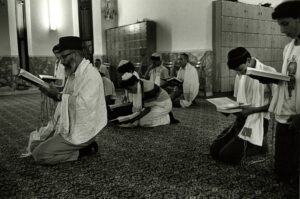
Full Prostration: Unlike Rabbinic synagogues, where one prays sitting or standing, Karaites pray on their knees and perform full prostration (Hishtajavayah), touching the ground with their foreheads. Their synagogues are usually covered with carpets, and they are entered without shoes to maintain the sanctity of the space.
-
Twice a Day: Based on the daily sacrifices described in the Tanakh (the Tamid of the morning and afternoon), Karaites establish two mandatory prayer times, unlike the three prayers (Shacharit, Mincha, and Ma’ariv) of the Rabbinic system.
-
Psalms and Scripture Only: Their liturgy avoids medieval hymns or the compositions of the Sages, focusing almost exclusively on biblical verses and Psalms.
Identity and Traditions:
Karaism is also distinguished by what it does not do, eliminating traditions they consider human inventions without a basis in the Tanakh:
-
Use of the Kippah: For a Karaite, covering the head is a sign of respect or a cultural custom (minhag), but not a legal obligation. They do not consider the biblical text to require the permanent use of the kippah, so many only cover themselves during prayer or study.
-
Post-Biblical Holidays: Karaism does not celebrate holidays that are not explicitly commanded in the Torah of Moses. Therefore, they do not celebrate Hanukkah (which commemorates events from the Maccabean period) nor do they consider Purim a mandatory religious holiday with a Megillah reading in the synagogue, though they recognize the historicity of the Book of Esther.
-
Interpretation of Tefillin: While Rabbinic Judaism interprets “bind them as a sign on your hand” literally (using leather boxes), Karaites understand it as a metaphor for carrying the commandments in the heart and mind at all times; thus, they do not use physical phylacteries.
This rigour in literal interpretation makes Karaite life paradoxically simpler in its requirements for religious “objects,” yet much more demanding in the direct observation of nature and the pure text.
4. The Golden Age of Karaism.
Between the 9th and 11th centuries, Karaism experienced its “Golden Age.” Thanks to their emphasis on grammar and philology, Karaite scholars were pioneers in the scientific study of Hebrew. Their influence was so vast that it is estimated they came to represent nearly 40% of the world’s Jewish population.
Centers such as Jerusalem, Cairo, and later Crimea and Lithuania, teemed with debates between “Rabbanites” and “Karaites.” It was precisely this intellectual pressure that forced Rabbinic leaders like Saadia Gaon to refine Jewish philosophy and the defense of the Talmud to prevent Karaism from becoming the dominant current.
5. Karaism Today.
After centuries of persecution and a numerical decline following World War II, the center of gravity for Karaism shifted from Egypt to Israel, although many communities are still found in the Diaspora.
Today, approximately 30,000 to 40,000 Karaites live in Israel, concentrated mainly in cities such as Ramla (where their Great Synagogue and administrative center are located), Ashdod, and Beer Sheva.
-
Legal Status: They are recognized as Jews by the State of Israel (under the Law of Return), but they maintain their own religious court for matters of marriage and divorce.
-
Preservation: They struggle to keep their liturgical language and unique culinary and religious traditions alive, integrating into modern Israeli society without renouncing their identity as the last guardians of the pure text.
Karaism reminds us that Judaism has never been a monolithic block, but a constant—and sometimes fierce—dialogue between the written letter and the voice of tradition.
Author: Dr. Liber Aguiar
0 Comments