 The Eighth Day
When the seven days of Sukkot come to an end, a different day arrives: Shemini Atzeret, the celebration of the eighth day. Its name says it all: it is one day after the seven days of Sukkot, and from this it takes its name.
Just as Shavuot closes the spring festivals, Shemini Atzeret closes the winter festivals. But it is not simply “one more day of celebration.” It is something else.
“Stay a Little Longer with Me”
Through this celebration, God invites us to remain longer with Him, even when a festival as extended as Sukkot has ended. After days of repentance and of dwelling in the sukkah, the reason for this day lies in dwelling in His presence.
It is like when the visitor you love most is about to leave and you say to them: stay one more day. That is Shemini Atzeret: God asking us for one more day with Him.
A Nuptial Feast on Intimacy with God
This festival was always regarded as a high expression of intimacy with God, and it is seen symbolically as a nuptial encounter between Him and His people.
In this context, Shavuot is seen as the feast of the marriage contract, and Shemini Atzeret as the moment of greatest intimacy: the consummation of that contract. It is not the feast of the crowd or of the noise; it is the feast of the face-to-face encounter.
Rejoicing in the Scripture
In the days of the Second Temple, the celebration of Shemini Atzeret was combined with another meaning: Simchat Torah, the rejoicing in the Scripture, which marks the end of the Torah reading cycle and the beginning of a new cycle.
With the destruction of the Temple and the reduction of the reading cycle from three years to one, the meaning of Simchat Torah remained as the principal one of that day, although the distinctive rejoicing of Shemini Atzeret was always very marked.
In Way Up, as we return to the triennial cycle of the parashot — the three-year cycle of New Testament times — we celebrate Simchat Torah at this time: when the cycle is completed, the reading of the end is added (by a “bridegroom of the Torah,” the Chatan Mesayem, the one who finishes) together with the reading of the beginning of the new cycle (by the other bridegroom, the Chatan Mathil, the one who begins).
That is why on Simchat Torah both portions are read: the one that closes and the one that opens. We finish the journey… and we begin again.
How Is This Feast Lived?
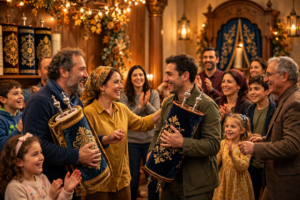
With overflowing joy. When Simchat Torah is celebrated, the community’s copies of the biblical texts are brought out, and in dancing processions people sing around them, celebrating the rejoicing for the study and teaching of the divine message in His Scripture.
It is a day of service with praises and dances, and of Seudah Hamitzvah, the festive meal of the commandment, shared in community.
Finishing to Begin Again
There is something profoundly beautiful about this feast: we celebrate not only what we finish, but what we are about to begin. The Word is not exhausted; it is completed and begins again, like a river that never stops flowing.
This Simchat Torah, do not stand watching from afar. Take hold of the Scripture, dance with it, sing to it, and begin the cycle anew with a burning heart. Because in the end, that is what it is all about: remaining one more day with Him… and then another, and another, until His presence becomes our home.
Chag Sameach! Happy Simchat Torah! 🎉📜
Author: Dr. Liber Aguiar
0 Comments